
Councillors unanimously let Horton Brook Quarry run to June 2028, over the parish council's objection. What was approved, and the ecology condition added.
Update, 15 September 2026: councillors approved the extension. The draft minutes of the Windsor and Ascot Development Management Committee on Thursday 3 September record a unanimous named vote to grant permission, in line with the officer recommendation. The approval includes the conditions in section 12 of the report, an updated legal agreement and a revised ecology condition from the update sheet. The quarry can now run to June 2028. (Draft minutes, 3 September 2026)
The revised ecology condition, number 43, requires:
- an ecological mitigation plan within four weeks of the decision
- no further bund removal, tree felling or changes to the site’s seven drainage ponds until the council accepts that plan
- updated protected species surveys in summer 2027, submitted by 10 July 2027
(Committee update sheet, 26/00543/VAR) The update sheet recorded no further letters after the report was published. The agent for the application was the only registered speaker. The article below was published before the vote.
Horton Brook Quarry was supposed to stop work in June. It did not, and on 3 September councillors were asked to let it carry on until June 2028.
The site is a 55 hectare sand and gravel workings east of Horton Road, about three miles east of Windsor town centre, between Horton village and Colnbrook. Officers are recommending approval. Horton Parish Council objects “in the strongest terms possible”. (Agenda, Windsor and Ascot Development Management Committee, 3 September 2026)
The clock has been extended twice already
The permission goes back to a planning inspector, who allowed it on appeal on 2 September 2008 after the council had refused it. Extraction started in January 2010.
- The original condition allowed 13 years from the start, so work should have finished in December 2022.
- A section 73 application permitted on 27 December 2018 stretched that to 15 years, giving a current end date of June 2026.
- This application would make it 17 years, moving the end date to June 2028.
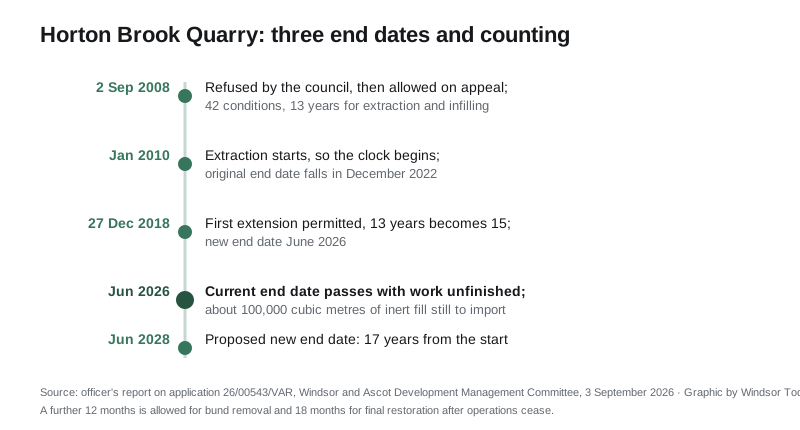
The officer’s report is clear that the mineral has gone. There is nothing left to extract. What remains is roughly 100,000 cubic metres of imported inert fill, to raise the ground back to its recorded levels, then the removal of the earth bunds and the plant.
The applicant told the council that even if this application were refused, the earliest achievable restoration would be December 2026.
What the parish council said
Horton Parish Council’s objection is printed in full in the report. Its second point is the sharpest:
At the initial appeal the Secretary of State accepted that the air quality in Horton is bad, did the Secretary of State imagine the 13 years would now be potentially extended to 35 years?
The parish council also says the site is no longer used for gravel alone. It points to the storage of vehicles and equipment belonging to another business. If the extension is granted, it wants an enforceable condition ruling out any further one.
One neighbour also objected, describing earth moving machinery working close to their property from 7am, and asking for stronger dust suppression, restricted hours, noise monitoring and a defined final end date.
There is a wrinkle in the council’s reply to that last point. The report answers the “no further extensions” objection by quoting condition 38, and the wording it quotes is the existing 15 year version. The condition actually recommended for approval, in section 12 of the same report, says 17 years.
Two consultees objected on ecology
Most statutory consultees raised no objection, including the Environment Agency, Natural England, the lead local flood authority and the council’s own environmental protection officer. Highways England had no objection provided the conditions stay as they are.
Two did object, both on ecology. The council’s own ecology officer says additional surveys are required and the method statements need updating. The Nature Space Partnership objects over the possible presence of great crested newts, and asks for more surveys or for the applicant to join the district licensing scheme.
The conditions that stay in place
Officers stress that this application changes one date and nothing else. Every other control carries over, including:
- HGV movements over 7.5 tonnes capped at 200 a day Monday to Friday, 100 in and 100 out, and 120 on a Saturday.
- Operating hours of 7am to 6pm Monday to Friday and 7am to 1pm on Saturday, with nothing on Sundays or bank holidays without written approval.
- Inert fill deliveries only between 10am and 5pm on weekdays and 10am to 1pm on Saturdays.
- Reversing alarms silenced using white noise technology.
- A daily record of HGV movements, to be produced for the council within two weeks of a written request.
The report adds that no objection has been recorded from the council’s environmental protection department about the running of the site since 2010.
The bigger scheme behind the two years
The extension is not only about finishing the fill. The applicant also wants time to prepare a separate “doming” scheme. It would reshape the restored land using material from the permanent inert waste recycling facility approved on the northern 12 hectares of the site in October 2023.
That scheme is expected to be submitted later in 2026. It is not being decided on Thursday, and the report gives it limited weight. But it is the reason the bunds, and the 37,000 trees the applicant says have been planted around them, would stay in place rather than being stripped out now.
What it means for you
- The Windsor and Ascot Development Management Committee meets at 6pm on Thursday 3 September 2026 in the Grey Rooms, York House, Windsor. It is a public meeting.
- The quarry item is the only application on the agenda.
- The application reference is 26/00543/VAR. Its status is still “awaiting decision” on the council’s planning register.
- There is a date to watch. The agenda front sheet and the planning register both give an agreed expiry date of 9 September 2026. Paragraph 1.10 of the officer’s report says an extension of time to 21 September 2026 has been agreed with the applicant.
- The agenda names the applicant as “Jaylex Aggregates Ltd”. The report body and the companies register both spell it Jayflex, as JAYFLEX (AGGREGATES) LTD, company number 03415570.
Horton, Datchet and Wraysbury are in the Royal Borough, so borough services apply: see our Windsor bin collection days and council tax bands pages. We track the borough’s live cases on the Windsor planning news page.
Have your say