
Councillors lose the power to send a planning application to committee on 1 November. The borough voted unanimously against the change and adopts it anyway.
From 1 November a councillor in Windsor, Maidenhead or Ascot will no longer be able to send a planning application to a committee. The power that lets a ward member pull a scheme out of the officers’ in-tray and into a public meeting is being abolished, in this borough and in every other council in England.
Full Council is asked to write that into the Royal Borough’s constitution tonight, at 7pm in the Council Chamber at Maidenhead Town Hall. The meeting is also on the council’s YouTube channel.
The same councillors voted unanimously against the change five months ago.
What the new rules actually do
The change comes from the Town and Country Planning (Discharge of Local Planning Authority Functions) (England) Regulations 2026, made on 15 July and in force on 31 October. They apply to every English planning authority.
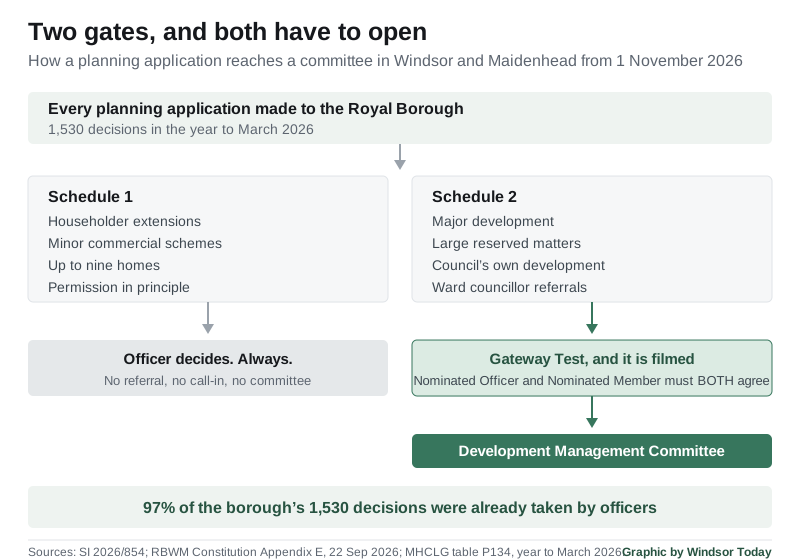
The council’s new terms of reference for its two Development Management Committees are set out in Appendix E of tonight’s Constitution Amendments report. They say the committees “will determine only” applications that clear two hurdles at once:
- the application falls under Schedule 2 of the national scheme, or the council itself has an interest in it; and
- a Gateway Test has been “undertaken and passed” by a Nominated Officer and a Nominated Member.
The document then removes any wriggle room. “For the avoidance of doubt any application which does not meet the criteria in (I) will be delegated to officers in all circumstances.”
From 1 November the Gateway Test itself only runs on a short list:
- new full or outline applications that count as major development, whatever the officer recommendation
- reserved matters on a large outline permission of 500 or more homes, or 50,000 square metres or more of floorspace
- applications referred by a ward councillor, within the rules below
- applications by a councillor or a member of their family, where somebody has written in
- applications by an officer involved in planning decisions, again only where somebody has written in
- anything the Assistant Director of Planning, a committee chair or the planning cabinet member refers in writing
- the council’s own development, and private applications on borough land
Everything else goes to an officer.
The gateway meetings will be filmed
One local decision is worth noting, and it is a good one.
The regulations say nothing about how a gateway decision is taken or who may watch it. The Royal Borough’s version says plainly that the Gateway Test “will be undertaken by a Nominated Officer and Nominated Member, which will be filmed”. Nothing obliged the council to do that.
The two decision-makers are named by role rather than by person. The Lead Nominated Officer will be the Assistant Director of Planning only. The Lead Nominated Member will be the chair of the relevant area committee, with the vice-chair also a Nominated Member. That is Councillor Mark Howard for Maidenhead and Councillor Neil Knowles for Windsor and Ascot.
Both must agree, and both must find that the application “raises a significant planning matter” or “raises an economic, social or environmental issue of significance”. If either says no, the officer decides.
What a ward councillor can still do, and what it is worth
A ward member keeps a right to ask, not to insist. The council’s tracked changes put it bluntly: making a request “simply secures consideration against the statutory criteria and does not guarantee a Committee determination”.
To be valid, a referral must:
- be made in writing on the councillor referral pro forma
- arrive before the neighbour consultation expiry date
- relate to the councillor’s own ward, or a neighbouring ward whose member has been told
- explain which statutory gateway criterion it meets
- be one of a defined sub-set, which excludes householder, minor commercial and minor residential applications
That last line is the one residents will feel. The regulations define a minor residential application as one for “at least one but not more than nine dwellings”, and Schedule 1 puts it in the list of applications that “must be determined by an officer”. So can a householder extension, a minor commercial scheme and an application for permission in principle. Those cannot be referred, cannot be called in, and cannot reach a committee at all.
The council voted against this, unanimously
On 21 April 2026 Councillor Adam Bermange put a motion to Full Council opposing the draft regulations. More than five councillors asked for a named vote. The minutes record 33 councillors voting For and none against, and the resolution is minuted as “AGREED UNANIMOUSLY”.
The debate ran through most of the chamber. Councillor Neil Knowles, who chairs the Windsor and Ascot committee, said removing call-in would reduce councillors “to little more than parish-style advocates”. Councillor Gurch Singh gave an example from St Mary’s ward where a call-in had got a green wall put back in place of an advertising billboard. Councillor Jack Douglas warned that planning officers would become “the focus of public blame and hostility” once elected members were out of the way.
Councillor Bermange is now the Cabinet Member for Adult Services, Planning and Governance, and tonight’s report is his. It records that the Constitution Working Group “referenced unanimous agreement by Council in April 2026 against these proposals, however, reluctantly recommend that the proposed updates to Parts 6 and 7B of the Constitution are adopted”.
The reason given is not that officers changed their minds. It is that “failure to implement the changes would lead the council unable to determine many planning applications lawfully from 1 November 2026”, and that “the government have indicated that they are likely to intervene where councils fail to” make the changes.
How much is actually changing
Less than the row suggests, on the numbers, and that cuts both ways.
Officers already take almost all of it. MHCLG’s live table P134 records 1,530 planning decisions in Windsor and Maidenhead in the year to March 2026, of which 97% were delegated to officers. The England figure is 96%. The committees were already handling the last few per cent.
The committees are not busy. Across 2026 the Maidenhead committee cancelled two meetings outright: 17 March, “due to there being no items of business for the Committee to consider”, and 21 May, “as there are no items on the agenda”.
One borough figure stands out, and it is the reason the argument here is not really about volume. Windsor and Maidenhead granted 72% of the applications it decided, against 87% for England. That is the sixth lowest approval rate of the 310 English district planning authorities in the table, and comfortably the lowest in Berkshire: Wokingham granted 94%, West Berkshire 90%, Bracknell Forest 89%, Reading 84% and Slough 78%. The figure covers every decision, not only committee ones.
The golf club row is written into the new rules
One clause reads like a direct answer to this month’s argument over the Maidenhead Golf Club scheme.
On 9 September the Maidenhead committee approved a variation to the CALA Homes permission on Harvest Hill Road. The minutes record six councillors present and note that four of them, Councillors D Davies, Gosling, Knowles and Wilson, “attended as substitutes”. The chair opened the meeting by reading a statement saying he understood “allegations had been made concerning the composition and impartiality of the Committee”.
The new terms of reference say that where a variation of conditions application or a reserved matters application comes back to committee, “as far as is possible, the Ordinary Members to be summoned in the Notice of Meeting shall be those Members that were present in the room when the decision on the related primary application was made”.
There is a second twist. The golf club application was a Section 73 variation. Appendix E records that Section 73 and 73A applications “are delegated matters unless called in”. From 1 November, a decision that took two committee meetings and produced a councillor walkout would start life on an officer’s desk, and would only return to a committee if a ward member asked and two people agreed.
What it means for you
- If you object to a planning application from 1 November, writing to your ward councillor no longer guarantees a public hearing. Your objection still goes to the case officer and is still a material consideration.
- Speaking rights at committee are not changing. What changes is how an application gets there, not who may speak once it does. The public speaking protocol is in Part 7F of the constitution.
- Small schemes are out of reach. Up to nine homes, householder extensions and minor commercial applications must be decided by an officer, with no route to a committee.
- Ask your councillor early. A referral has to arrive before the neighbour consultation expiry date on the application, which is published on the planning register.
- Watch for the first gateway decisions. The tests will be filmed. We will report the first batch, and if none is published after 1 November that is worth knowing too.
We track borough applications on our Windsor planning news page.
Frequently asked questions
When does planning call-in end in Windsor and Maidenhead?
The regulations come into force on 31 October 2026 and the council’s own rules take effect from 1 November. Full Council was asked to adopt the constitutional changes on 22 September 2026.
Can I still object to a planning application?
Yes. Nothing in the change affects your right to comment on an application. Objections still go to the case officer and remain a material consideration. What changes is that your ward councillor can no longer guarantee the application is heard in public.
Can my councillor still get an application heard in public?
Only by asking, and only for certain applications. A ward councillor may submit a written referral on a pro forma before the neighbour consultation expiry date, explaining which statutory criterion the application meets. A Nominated Officer and a Nominated Member then decide together whether it goes to committee. The council’s own wording is that a request “does not guarantee a Committee determination”.
Which applications can never go to a committee now?
Householder applications, minor commercial applications, schemes of up to nine dwellings, and permission in principle. Schedule 1 of SI 2026/854 says these must be determined by an officer.
Can I still speak at a planning committee?
Yes. Public speaking rights are unchanged. The protocol is in Part 7F of the council’s constitution. The change is to how an application reaches the committee, not to what happens once it is there.
Sources
- Royal Borough of Windsor and Maidenhead, Council agenda, 22 September 2026, item on Constitution Amendments.
- Constitution Amendments report, paragraphs 2.6 to 2.9 and 5.2.
- Appendix E, Part 6, Planning Terms of Reference.
- Appendix B, tracked changes, Part 7B.
- Full Council printed minutes, 21 April 2026, motion by Councillor Bermange and the named vote.
- Maidenhead Development Management Committee printed minutes, 9 September 2026.
- The Town and Country Planning (Discharge of Local Planning Authority Functions) (England) Regulations 2026, SI 2026/854.
- Ministry of Housing, Communities and Local Government, planning application statistics live tables, table P134, year ending March 2026.
Have your say