
Grant Thornton has lifted five of its six key recommendations to the Royal Borough. The one left says council tax rises are the only credible route off government support.
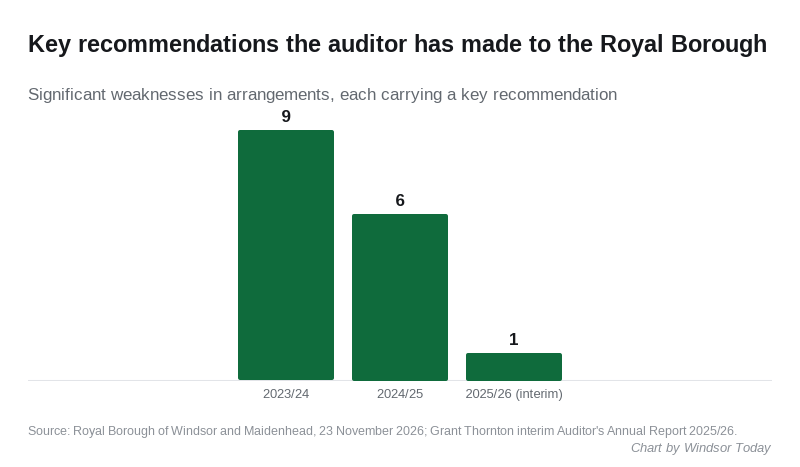
The Royal Borough’s auditor has dropped five of the six key recommendations it made last year. Two years ago there were nine.
The one that remains is about money, and it is blunt. Grant Thornton says raising council tax towards the national average over the next two years is “currently the only credible route” for the council to stop depending on Exceptional Financial Support.
The findings are in the interim Auditor’s Annual Report for 2025/26. The council’s Audit and Governance Committee will consider it on Monday 30 November at 6.30pm. The council announced the report on 23 November.
What the auditor found has improved
The auditor’s report credits the council with “substantial progress in improving its financial sustainability since 2023/24 when it was unable to deliver a balanced budget”. Among its findings:
- a £3.079m underspend in 2025/26
- general fund reserves up from £10m to £16.9m over the year, just above the council’s £15m minimum
- savings that beat the 2025/26 target by £382,000 (6.4%)
- an internal audit opinion of “reasonable assurance”
- a more accurate contracts register, updated procurement rules and staff trained in them
That progress let the auditor remove five key recommendations. The council says they covered savings and transformation, internal audit and assurance, property and development governance, and procurement and contract management.
On governance the auditor found no significant weaknesses at all this year. It describes “sound governance processes to manage finance, transformation, improvements and performance”, with “a coherent and consistent approach modelled by Cabinet and senior officers”. It still made three smaller improvement recommendations on governance.
The warning that stays
The remaining significant weakness is the council’s medium-term finances. The auditor rates financial sustainability red.
Its key finding says the council’s future funding gaps, including the effect of the government’s Fair Funding Review, mean it “will continue to have an unsustainable dependence on EFS unless substantial increases in locally generated and/or grant income can be secured”.
The report gives two reasons. The first is “historical decisions to set low levels of council tax”. The second is the Fair Funding Review, which the auditor says “will remove £30m in funding over the next three years”.
Exceptional Financial Support is government permission to borrow to cover day-to-day spending. The council is relying on £48.754m of it this year.
The government has given the Royal Borough a way out that most councils do not have. For the next two years it can raise council tax by any amount, up to the national average, without holding a referendum. The auditor calls this “the only option available to the Council to improve its medium-term financial position”, alongside the savings work already under way.
The council’s own chief finance officer, the section 151 officer, has gone further. The report says the officer has recommended “in the strongest possible terms” that the council raise council tax to the national average over that period.
The auditor’s revised recommendation asks the council to give “active consideration” to that advice. It also points to the Financial Improvement and Sustainability Board, the independently chaired panel that oversees the recovery, which has recommended the council “fully utilises the flexibilities”. Council management has agreed the recommendation, with a due date of 31 March 2027.
What the council says
Councillor Lynne Jones, Deputy Leader and Cabinet Member for Finance, said the report was “independent recognition of the significant progress we have made”.
“Just two years ago, auditors identified nine significant weaknesses in the council’s arrangements,” she said. “The fact that only one recommendation now remains is a clear demonstration of how far the borough has come.”
She added that there was more work to do, and that she would “make the strongest possible case to government for a fair funding settlement”.
The council’s announcement does not mention the section 151 officer’s advice on council tax.
The accounts are still being audited
This report is about how the council runs itself, not a sign-off of its accounts. The audit of the 2025/26 financial statements is not finished.
Grant Thornton says it agreed with senior finance officers on 5 November to carry that work on beyond 30 November. It is also still considering one objection to the 2025/26 accounts, made under section 27 of the Local Audit and Accountability Act 2014.
The auditor made no statutory recommendations and did not use any of its other formal powers.
What it means for you
The size of next year’s council tax bill is now the central question. The auditor, the council’s own finance chief and the independent recovery board are all pointing the same way: bigger rises, towards the national average, over 2027/28 and 2028/29.
That decision belongs to councillors, who set the 2027/28 bill in the new year. The current band D charge, and how it compares, is on our Windsor and Maidenhead council tax bands page.
The papers for the Audit and Governance Committee on 30 November are on the council’s meetings site.
Have your say