
Should Windsor and Maidenhead each get a town council from May 2028, paid for by a new precept? Have your say by 30 Sep; parishes now charge £39 to £159 at Band D.
Residents of Windsor and Maidenhead have until Wednesday 30 September to say whether they want a town council of their own, which services it should run, and how much extra council tax they would pay for it. The Royal Borough opened the consultation on 5 August as the first stage of a community governance review of the borough’s only two unparished areas, and says that if the idea goes ahead the first town council elections would be held in May 2028. (RBWM news, 5 August 2026; RBWM Engage, community governance review)
The two towns are the odd ones out. Everywhere else in the borough, from Bray and Cookham to Datchet, Eton and Sunninghill and Ascot, already has a parish council that sets its own precept and spends it locally. The terms of reference for the review count fifteen parishes (fourteen parish councils and one parish meeting), seven of them divided into wards, all elected every four years alongside the borough. Windsor and Maidenhead town centres and the estates around them have nothing at that level. (Terms of reference, published 13 July 2026, section 3)
What is on the table
The review area for Windsor is twelve polling districts spanning the wards of Clewer East, Clewer and Dedworth East, part of Clewer and Dedworth West, part of Eton and Castle and part of Old Windsor. For Maidenhead it is seventeen polling districts across Belmont, Boyn Hill, Furze Platt, part of Oldfield, Pinkneys Green, Riverside and St Mary’s. Together those two areas make up more than half of the borough’s council tax base: 37,363 Band D equivalent properties out of 72,219 in 2026/27. (Terms of reference, sections 2.2 and 2.3, and Appendix 3)
The document is careful to say that “no change” is a live option for either town, and that the two will be judged separately, so one could get a town council and the other not. If a council is created it could cover all or only part of the review area, and could be a single unwarded body or divided into wards, possibly one for each borough ward it spans. The legal minimum is five councillors; there is no maximum. (Terms of reference, sections 4.1 to 4.6)
Two conditions run through the whole thing. First, any new arrangement must be financially neutral to the borough’s own budget: “only options that result in a neutral or positive financial impact on the council budget will be taken forward to public consultation”. Second, the council gives “no assurance” that money will be found for extra town council elections in 2028; that would have to be argued for in the 2028/29 budget round. Which services would move across, and how any transfer would be phased, is left for a later stage. (Terms of reference, sections 4.7, 4.8 and 5.6)
What a precept costs elsewhere in the borough
The council’s own release says a town council “would be funded through a dedicated council tax precept, resulting in an additional charge on council tax bills”, and the survey asks what annual precept residents would be prepared to pay. The terms of reference give the yardstick: every parish’s 2026/27 precept, expressed as a Band D charge. (RBWM news, 5 August 2026; Terms of reference, Appendix 3)
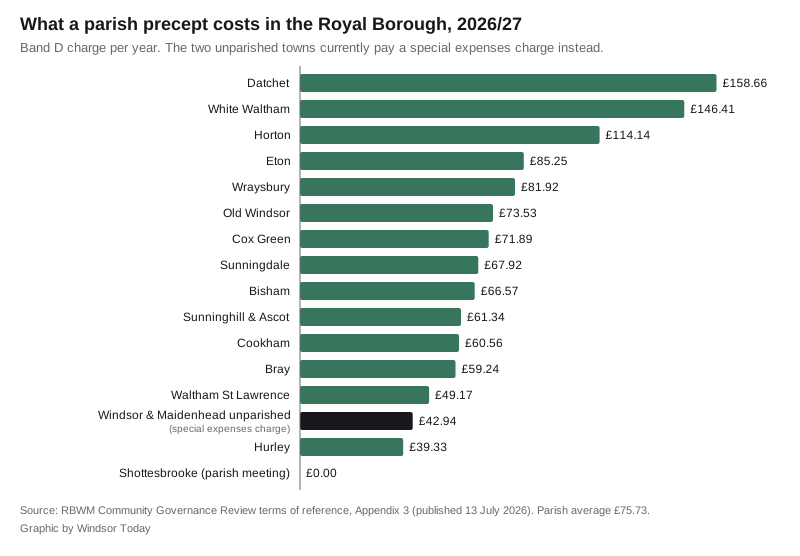
The range is wide. Datchet charges the most at £158.66 a year for a Band D home, after a 36.1 per cent rise this year, followed by White Waltham at £146.41 and Horton at £114.14. Eton is £85.25, Wraysbury £81.92 (up 19.5 per cent), Old Windsor £73.53 (frozen), Cox Green £71.89, Sunningdale £67.92 (the only cut, down 2.5 per cent), Bisham £66.57, Sunninghill and Ascot £61.34, Cookham £60.56, Bray £59.24 and Waltham St Lawrence £49.17. Hurley is the cheapest parish council at £39.33, and tiny Shottesbrooke, a parish meeting, charges nothing. The average across the parishes is £75.73. (Terms of reference, Appendix 3)
The same table lists the unparished areas of Windsor and Maidenhead under “precepts / special expenses” at £42.94 for Band D in 2026/27, up 7.48 per cent, raising £1,604,350. Whether that charge would continue alongside a town council precept, or be folded into it, is not addressed in the terms of reference. It is a fair question to put in a consultation response. (Terms of reference, Appendix 3)
Who decides, and when
Draft and final recommendations will be written by a cross-party working group of seven councillors: four Liberal Democrat, one Conservative, one Local Independent and one Independent Alliance, reflecting current group sizes. The timetable in the terms of reference runs:
- August to September 2026: first consultation, on the terms of reference and current arrangements (closes 30 September).
- December 2026: draft recommendations published.
- January to February 2027: second consultation, on the draft recommendations.
- July 2027: final recommendations to full council.
- October 2027: reorganisation order made, if the answer is yes.
- 4 May 2028: elections to a Maidenhead town council and a Windsor town council, if created.
All representations received, and the working group’s minutes, are to be published on the council’s website. (Terms of reference, sections 5.4, 5.8 and 6.2)
What it means for you
If you live in the review area, this is the stage at which the broad question is decided: whether to have a town council at all, what it should do, and roughly what it should cost. The second round in the new year will be about the detail of a specific proposal, so an argument for or against the principle is best made now.
If you already live in a parish (Bray, Cookham, Datchet, Eton, Old Windsor, Sunninghill and Ascot and the rest), nothing changes for you directly, but the terms of reference say existing parish councils are among those the borough must consult, and the borough’s “financially neutral” test means any services handed to a new town council would be ones the borough currently pays for out of everyone’s council tax.
How to respond: the online survey is at engage.rbwm.gov.uk and is open to anyone aged 16 or over; paper copies are available on request at borough libraries. Written representations go by email to CGRenquiries@rbwm.gov.uk or by post to Electoral Services, Royal Borough of Windsor and Maidenhead, Town Hall, St Ives Road, Maidenhead SL6 1RF. The deadline is Wednesday 30 September 2026. (RBWM Engage; Terms of reference, Table 2)
Windsor Today will report the draft recommendations when they are published in December. For the borough’s other live planning and governance decisions, see our Windsor planning news page.
Have your say