
RBWM wants to renew its barbecue ban and street-drinking powers for three years, with £100 fixed penalties; the draft covers every public place. Reply by 10 Sep.
The Royal Borough is consulting until Thursday 10 September on renewing two Public Spaces Protection Orders for another three years: one that lets officers order people to stop drinking or hand over their alcohol in named streets and parks across the borough, and one that bans barbecues and open fires. Both were first made in 2023. Anyone who refuses to comply with an authorised officer can be given a £100 fixed penalty notice. (RBWM news, 30 July 2026; RBWM Together, PSPO consultation)
The consultation page carries the two draft orders, and they are worth reading rather than taking the summary on trust, because the barbecue order as drafted is wider than the council’s description of it.
The barbecue order: the whole borough, not just parks
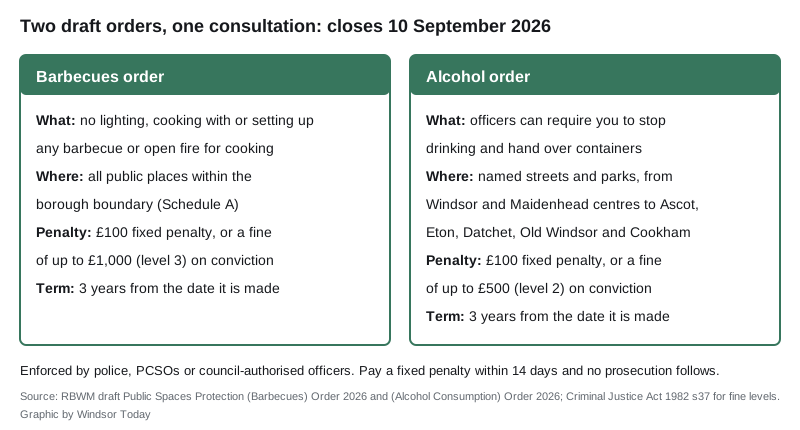
The council’s release describes the order as covering “council-owned parks and open spaces”, and the consultation page talks about “council parks and other open spaces owned and maintained by the Royal Borough”. The draft order itself says something broader. Its restricted area is defined in Schedule A as “all public places within the boundaries of the Royal Borough of Windsor and Maidenhead”, and the prohibition reads: “No person may light, cook with, set up or otherwise use a barbecue or barbecues in the Restricted Area.” A barbecue “includes any permanent, disposable, temporary, makeshift or homemade barbecue or any open fire for the purposes of heating or cooking food”. The order would apply “to all persons at all times” for three years from the date it is made. (Draft Public Spaces Protection (Barbecues) Order 2026, paragraphs 7 to 9 and Schedule A)
Breaching it is an offence under section 67 of the Anti-social Behaviour, Crime and Policing Act 2014, carrying a fine of up to level 3 on the standard scale on conviction, currently £1,000, or a fixed penalty notice; paying the fixed penalty within 14 days discharges any liability to prosecution. The council says fines are “at the officer’s discretion” and that “the purpose of this PSPO is not to issue fines” but to back up Community Wardens’ conversations with people who ignore park signage. (Draft Barbecues Order, paragraphs 10 and 11; Criminal Justice Act 1982, section 37; RBWM Together)
The alcohol order: not a ban, but a long list of places
The alcohol order is not a blanket ban on drinking in public. It creates a restricted area within which a police officer, PCSO or council-authorised officer can require someone whose drinking is linked to anti-social behaviour to stop, and to hand over any container believed to hold alcohol, sealed or not. Refusing is the offence, punishable by a fine of up to level 2 (£500) or a £100 fixed penalty. (Draft Public Spaces Protection (Alcohol Consumption) Order 2026, paragraphs 3 to 7; Criminal Justice Act 1982, section 37)
The schedule to the draft order lists the restricted area ward by ward. In Windsor it takes in the whole town centre: an area bounded by Alma Road, Clarence Road, Victoria Street, Sheet Street, Park Street, St Alban’s Street, Castle Hill, High Street, Thames Street, Thames Avenue, River Street, Barry Avenue, Goswell Road and Arthur Road, including the Alma Road car park, plus Alexandra Gardens, Bachelors Acre, Church Street Gardens, Lower Thames Street and the Windsor and Eton Bridge, the Windsor Leisure Centre car park and pleasure ground, the skate park on Vansittart Road, and the footway under the A332 bridge. In Maidenhead it covers the town centre inside Saint Cloud Way, Bad Godesberg Way, Frascati Way, Grenfell Place, Grenfell Road, Queen Street, York Road and Forlease Road, along with Kidwells Park and its skate park, Grenfell Park, the railway station forecourt, Library Square and the amphitheatre, and Desborough Park and Guards Club Park in Oldfield and Bray. (Draft Alcohol Order, Schedule)
Outside the two towns the list includes Ascot High Street, the station forecourt and Station Hill, Sunninghill High Street between Charters Lane and Kings Road, and Victory Fields; Eton High Street, The Brocas, Eton Recreation Ground and Eton Wick Recreation Ground; Datchet Recreation Ground; Old Windsor Recreation Ground and Straight Road; Clewer Memorial Recreation Ground and Dedworth Road; and, in Cookham, Alfred Major Recreation Ground and Station Parade. (Draft Alcohol Order, Schedule)
What the council says the orders have done
The borough says that in most cases people comply once the restrictions are explained, and it credits a set of recent measures, including PSPOs on catapult use and steps against ticket touting at Royal Ascot, with a 7 per cent fall in reports of anti-social behaviour in 2026. That figure is the council’s own and the release does not say what period it compares. Feedback from the consultation is to be analysed and shared with all councillors before Cabinet decides whether to continue the powers. (RBWM news, 30 July 2026; RBWM Together)
What it means for you
If you barbecue in a park or by the river: the existing rules already say no, and the renewed order would keep the £100 penalty behind them for three more years. As drafted, it would apply in any public place in the borough, not only council parks, so if that breadth matters to you, the consultation is the place to say so.
If you drink outdoors in one of the listed areas: the order does not stop you, but it gives police and wardens the power to make you stop, or hand over the drink, if your behaviour is causing a problem, and refusing is what triggers the fine.
How to respond: the survey is on RBWM Together and asks whether you agree with each order, for comments, and for your experience of other anti-social behaviour in public spaces. It closes on Thursday 10 September 2026. Once an order is made, anyone who lives, works or regularly visits the restricted area has six weeks to challenge its validity in the High Court. (Draft Alcohol Order, paragraph 8; Draft Barbecues Order, paragraph 12)
The borough is also consulting, until 30 September, on whether Windsor and Maidenhead should have town councils of their own; see our report on that consultation. For parks and open days out in the area, see things to do in Windsor.
Have your say